Haskell supply-chain security with cabal-plan-submit
2026-05-31
Making cabal-audit reports actionable with dependency paths, SARIF enrichment, GitHub Dependency Submission, and deprecated package detection using cabal-plan-submit.
Problem
cabal-audit reports vulnerabilities in dependencies based on security advisories like Haskell advisories, but open-source software maintainers often need to know:
- why is this dependency present?
- is it direct or transitive?
- if this is a deprecated dependency is there a known replacement?
- is this a test/spec/benchmark dependency or production one?
- what deprecated dependencies do I have?
Demo target
persistent a realistic datastore interface for Haskell.
Example cabal-audit with cabal-plan-submit
With locally cloned and built cabal-audit and persistent one can run:
~/persistent$ ~/cabal-audit/result/bin/cabal-auditand get report including:
Hackage package cryptonite at version 0.30 is vulnerable for:
  HSEC-2025-0002 "Double Public Key Signing Function Oracle Attack on Ed25519"
  published: 2025-11-14 14:45:34 UTC
  https://haskell.github.io/security-advisories/advisory/HSEC-2025-0002
  No fix version available
  crypto
There are 2 issues here:
- the report says
No fix version available - persistent does not depend directly on cryptonite
We can check in Haskell advisory for HSEC-2025-0002
that problem exists also in crypton in versions >=0.31 && <1.0.3.
To investigate further using cabal-plan-submit why this dependency is present:
~/cabal-plan-submit$ cabal run cabal-plan-submit -- why ~/persistent/dist-newstyle/cache/plan.json cryptoniteproduces:
cryptonite
paths:
  persistent-mongoDB-2.13.1.0
   -> mongoDB-2.7.1.4
   -> cryptohash-0.11.9
   -> cryptonite-0.30
and combine this with analysis of deprecated dependencies:
curl -L \
  https://raw.githubusercontent.com/commercialhaskell/all-cabal-metadata/master/deprecated.yaml \
  -o deprecated.yaml

~/cabal-plan-submit$ cabal run cabal-plan-submit -- inspect-deprecated --production-only ~/persistent/dist-newstyle/cache/plan.json deprecated.yaml
that shows:
deprecated packages:
  cryptonite-0.30
    relationship: indirect
    replacements:
      - cryptohash-md5
      - cryptohash-sha1
      - cryptohash-sha256
      - cryptohash-sha512
      - crypton
    used by path: persistent-mongoDB-2.13.1.0 -> mongoDB-2.7.1.4 -> cryptohash-0.11.9 -> cryptonite-0.30
  data-binary-ieee754-0.4.4
    relationship: indirect
    replacements:
      - binary
      - cereal
    used by path: persistent-mongoDB-2.13.1.0 -> bson-0.4.0.1 -> data-binary-ieee754-0.4.4
We discovered that cryptonite is deprecated and potential replacements are crypton and vulnerability is fixed there.
We even know that we should target mongoDB or cryptohash. Story continues in mongodb #161
Filtering noisy test/benchmark dependencies
Previously we used -production-only to ignore local modules that are most likely relevant for benchmarking and tests,
we can get all of them by:
~/cabal-plan-submit$ cabal run cabal-plan-submit -- inspect-deprecated ~/persistent/dist-newstyle/cache/plan.json deprecated.yamlwhich is a bit more noisy:
deprecated packages:
  cryptonite-0.30
    relationship: indirect
    replacements:
      - cryptohash-md5
      - cryptohash-sha1
      - cryptohash-sha256
      - cryptohash-sha512
      - crypton
    used by path: persistent-mongoDB-2.13.1.0 -> mongoDB-2.7.1.4 -> cryptohash-0.11.9 -> cryptonite-0.30
  data-binary-ieee754-0.4.4
    relationship: indirect
    replacements:
      - binary
      - cereal
    used by path: persistent-mongoDB-2.13.1.0 -> bson-0.4.0.1 -> data-binary-ieee754-0.4.4
  old-time-1.1.1.0
    relationship: indirect
    replacement: time
    used by path: persistent-2.18.1.0 -> quickcheck-instances-0.4 -> old-time-1.1.1.0
  system-fileio-0.3.16.7
    relationship: direct
    replacement: directory
    used by path: persistent-sqlite-2.13.3.1 -> system-fileio-0.3.16.7
  system-filepath-0.4.14.1
    relationship: direct
    replacement: filepath
    used by path: persistent-sqlite-2.13.3.1 -> system-filepath-0.4.14.1
Originally report mentioned also old-time that was pulled through unix-time:
cabal run cabal-plan-submit -- why --production-only ~/persistent/dist-newstyle/cache/plan.json old-time
old-time
paths:
  persistent-2.18.1.0 -> fast-logger-3.2.6 -> unix-time-0.4.17 -> old-time-1.1.1.0
  persistent-mongoDB-2.13.1.0 -> mongoDB-2.7.1.4 -> tls-2.4.1 -> unix-time-0.4.17 -> old-time-1.1.1.0
  persistent-mysql-2.13.1.6 -> monad-logger-0.3.42 -> fast-logger-3.2.6 -> unix-time-0.4.17 -> old-time-1.1.1.0
  persistent-postgresql-2.14.3.0 -> monad-logger-0.3.42 -> fast-logger-3.2.6 -> unix-time-0.4.17 -> old-time-1.1.1.0
  persistent-qq-2.12.0.7 -> persistent-2.18.1.0 -> fast-logger-3.2.6 -> unix-time-0.4.17 -> old-time-1.1.1.0
  persistent-redis-2.13.0.2 -> hedis-0.15.2 -> tls-2.4.1 -> unix-time-0.4.17 -> old-time-1.1.1.0
  persistent-sqlite-2.13.3.1 -> monad-logger-0.3.42 -> fast-logger-3.2.6 -> unix-time-0.4.17 -> old-time-1.1.1.0
but after merging https://github.com/kazu-yamamoto/unix-time/pull/68 this is no longer the case:
cabal run cabal-plan-submit -- why --production-only ~/persistent/dist-newstyle/cache/plan.json old-time
no path found to old-time
Note we used here again --production-only as without it we have:
cabal run cabal-plan-submit -- why ~/persistent/dist-newstyle/cache/plan.json old-time
old-time
paths:
  persistent-2.18.1.0 -> quickcheck-instances-0.4 -> old-time-1.1.1.0
  persistent-mongoDB-2.13.1.0 -> persistent-test-2.13.2.1 -> quickcheck-instances-0.4 -> old-time-1.1.1.0
  persistent-mysql-2.13.1.6 -> quickcheck-instances-0.4 -> old-time-1.1.1.0
  persistent-postgresql-2.14.3.0 -> quickcheck-instances-0.4 -> old-time-1.1.1.0
  persistent-sqlite-2.13.3.1 -> persistent-test-2.13.2.1 -> quickcheck-instances-0.4 -> old-time-1.1.1.0
  persistent-test-2.13.2.1 -> quickcheck-instances-0.4 -> old-time-1.1.1.0
Supply-chain security on Github and Haskell
According to Zero Day Clock, 74% of newly disclosed vulnerabilities in 2026 are estimated to have no known fix at disclosure time. Public package registries also have real infrastructure costs, so “just update everything immediately” is not always the best operational answer (see 1, 2).
For many ecosystems Github can automatically figure out what are dependencies of given project, so information from security advisories can be used by Dependabot and automatic PRs for dependencies where known vulnerabilities are can be created.
This works for Rust, Python, Java unfortunately GitHub does not understand dependencies in Haskell and Scala. See discussions here: security-advisories #11 and security-advisories #205.
Can we do better? cabal-plan-submit aims to improve this in two ways
Use GitHub dependency submission
cabal-plan-submit reads resolved cabal plan and convert it into snapshot accepted by GitHub dependency submission API
This can be configured on workflow like so:
  - name: Checkout cabal-plan-submit
    uses: actions/checkout@v6
    with:
      repository: dancewithheart/cabal-plan-submit
      path: cabal-plan-submit

  - name: Submit dependency snapshot
    env:
      GITHUB_TOKEN: ${{ secrets.GITHUB_TOKEN }}
      REPO: ${{ github.repository }}
    run: |
      owner="${REPO%/*}"
      repo="${REPO#*/}"

      response="$(
        curl \
          --fail-with-body \
          -X POST \
          -H "Accept: application/vnd.github+json" \
          -H "Authorization: Bearer $GITHUB_TOKEN" \
          -H "X-GitHub-Api-Version: 2022-11-28" \
          "https://api.github.com/repos/$owner/$repo/dependency-graph/snapshots" \
          --data-binary @snapshot.json
      )"

      echo "$response" | jq .
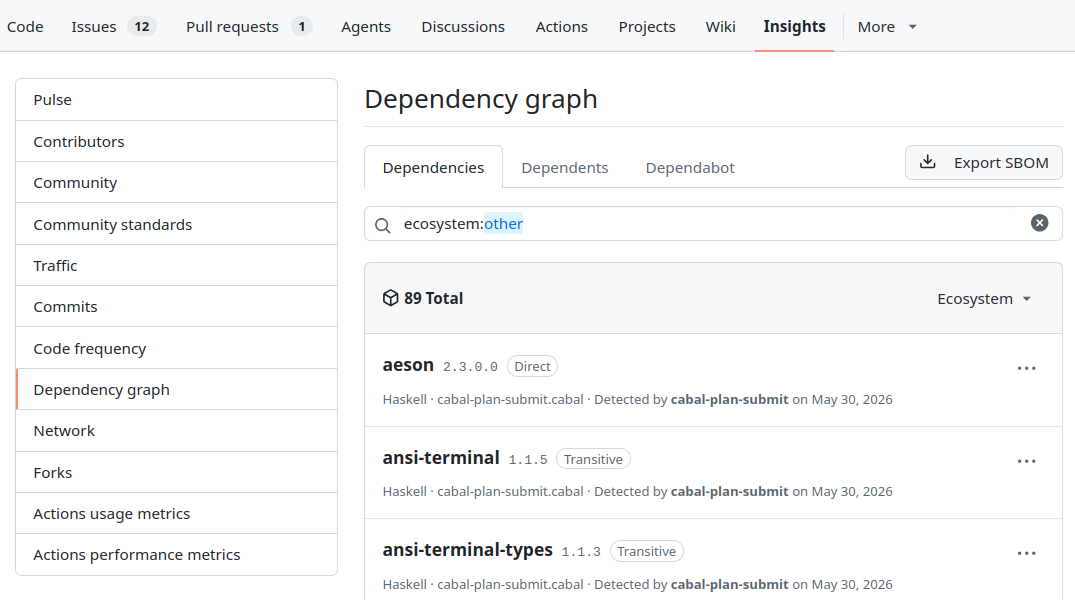
After this on you project Insights > Dependency graph should be populated with dependencies:
Enrich SARIF output from cabal-audit
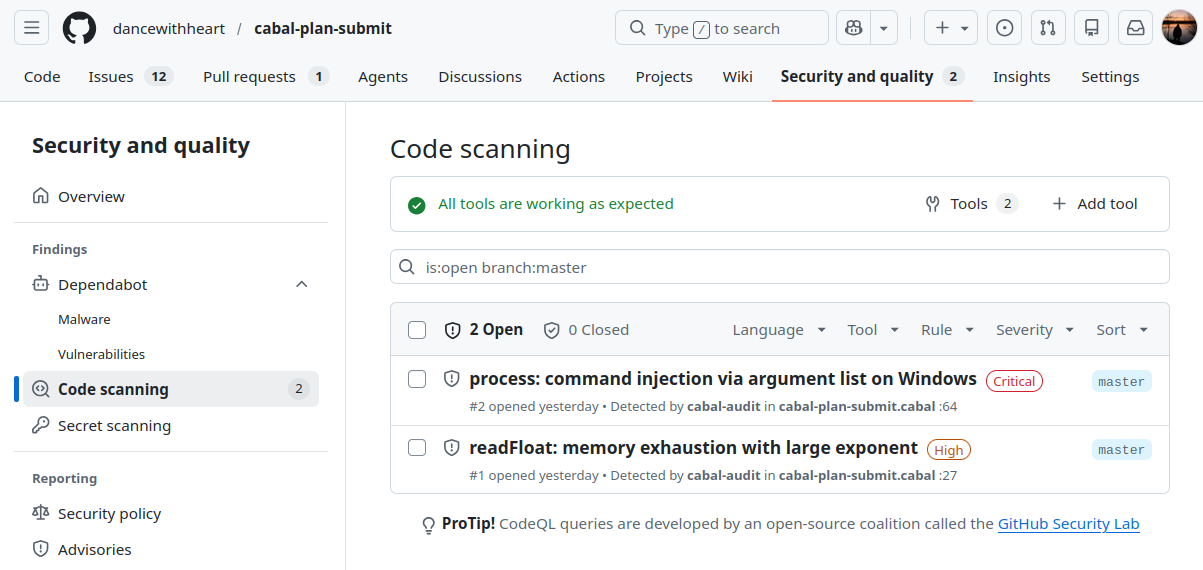
Report with vulnerabilities from dependencies can be exported in SARIF format and submitted to GitHub as code scan. This is very nicely automated thanks to haskell-security-action.
cabal-plan-submit thanks to knowledge of resolved dependencies can enrich this SARIF report with: - precise locations (see haskell-security-action #1 and haskell-security-action #5) - information if dependency is direct or transitive (cabal-audit #68)
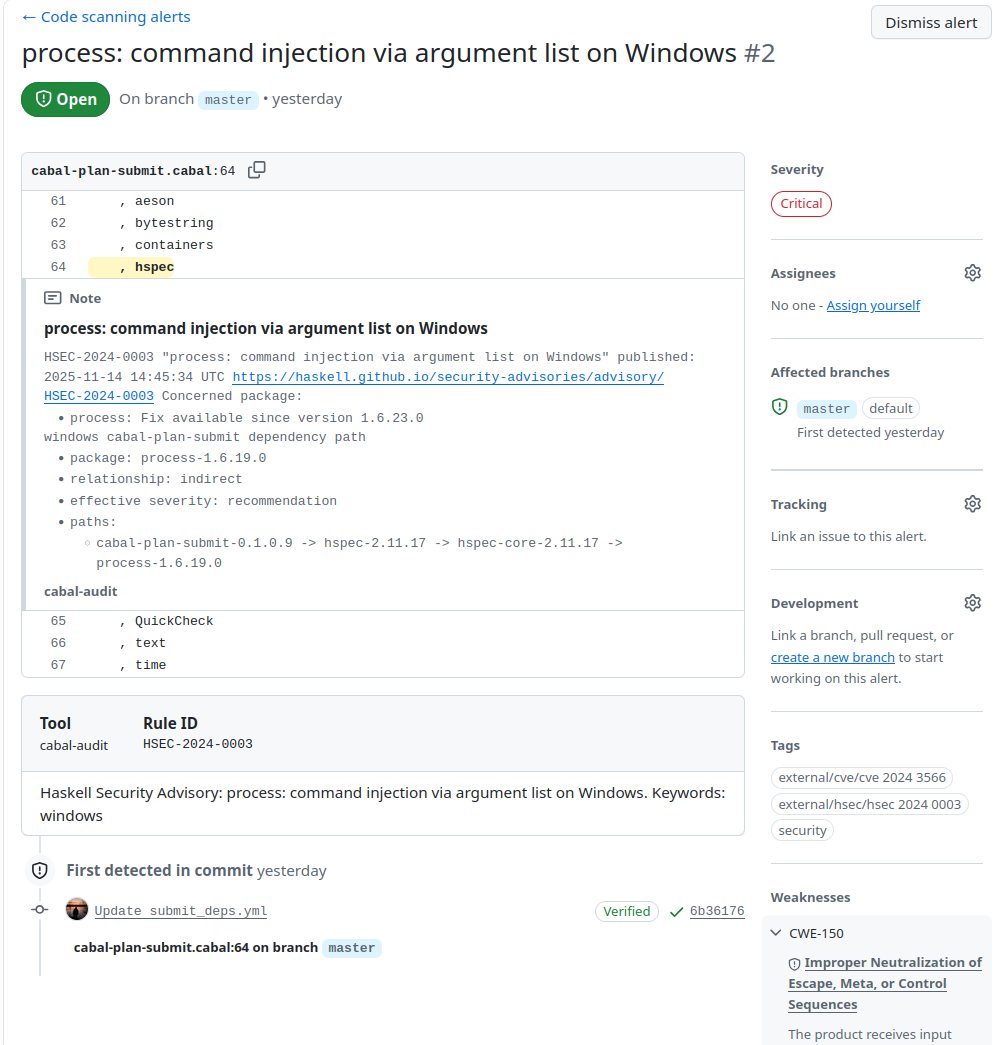
on the details for vulnerability you can see GitHub compute severity from CVSS vector (recently improved via security-advisories #322 and links CVEs thanks to exposed tags (see cabal-audit #75).
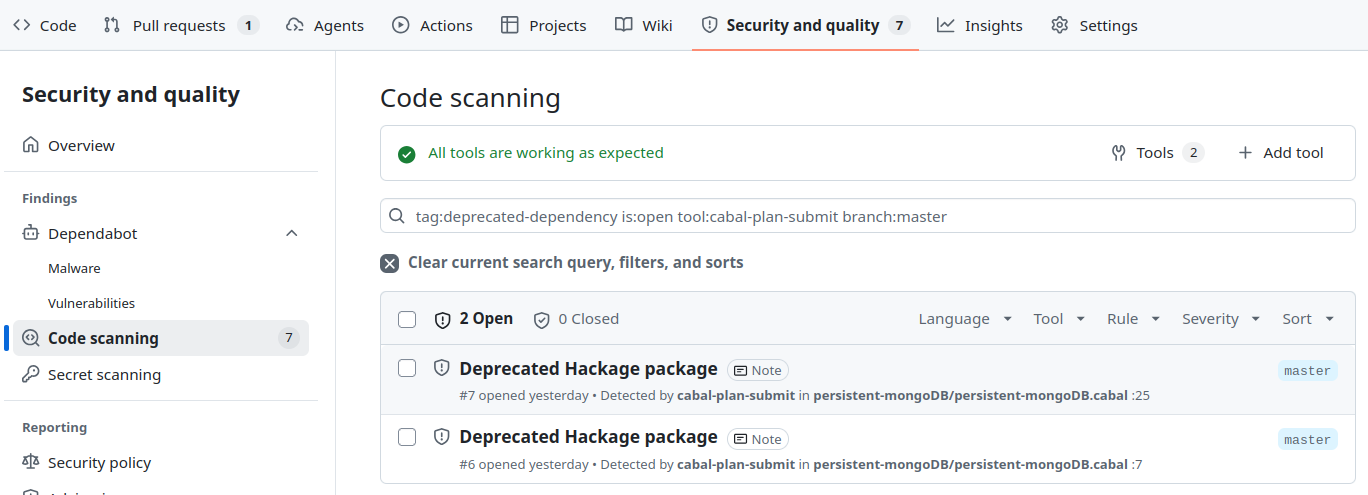
cabal-plan-submit can also generate information about deprecated dependencies, and tags to search:
Ecosystem integration
cabal-plan-submit is intended to complement & integrate (in Milestone 2) with existing Haskell security tooling.
Current discussions:
cabal2nix: using Hackage deprecation metadata and dependency-path logic in Nix-based Haskell workflows: cabal2nix #128cabal-audit: exposing useful SARIF tags and advisory metadata for GitHub Code Scanning: cabal-audit #75haskell-security-action: optional enrichment of cabal-audit SARIF using Cabalplan.json: haskell-security-action #9
Future directions
Current workflow:
cabal-auditproduces SARIF with vulnerability reportscabal-plan-submitenriches it using Cabal’s resolvedplan.jsoncabal-plan-submitcan also report deprecated dependencies and known replacements.
This could later be expanded in Milestone 3 with usage-aware analysis:
- static analysis inspired by Stan, for example to check whether vulnerable APIs are actually used: stan #483
- AI-assisted vulnerability triage experiments, for example using tools such as nano-analyzer, which explores lightweight LLM-based source-code security scanning.
The goal would be to move from “this dependency has an advisory” toward “this project depends on the vulnerable package through this path, and this code may or may not exercise the vulnerable API.”
Known limitations of cabal-plan-submit
- wrong cabal stanza fallback for package-level dependencies #22
- direct dependency should be preferred as primary location #21
- test/benchmark dependency classification needs refinement #26
PRs are very welcome :) There is planned work to resolve tech debt created while preparing the MVP.